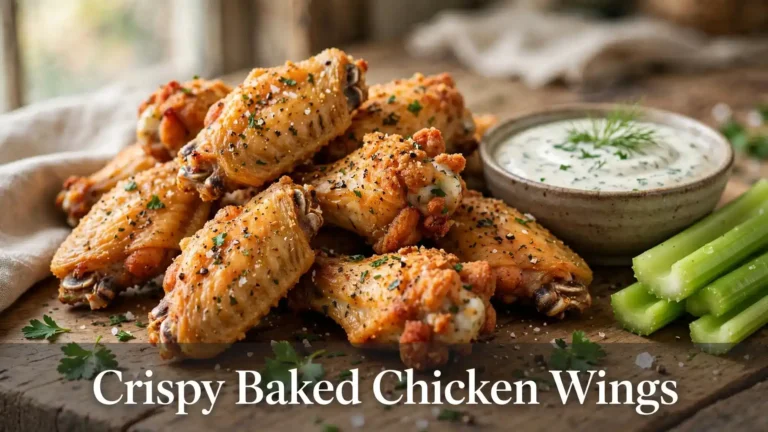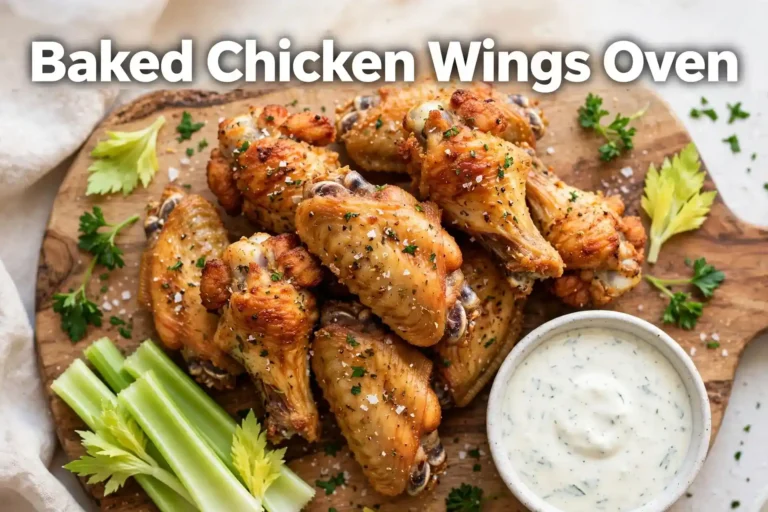
Baked Chicken Wings
Wings are one of the few foods that disappear from the plate faster than you can put them out. Friends hover around the kitchen, someone “just tries one,” and suddenly the tray is empty. The problem for most home cooks is that great wings seem to require a deep fryer, a vat of oil, and a kitchen that smells like a fast-food restaurant for three days.

They don’t. Baked chicken wings can come out with crackling, bubbly skin and juicy meat, as long as you handle the skin correctly. The method below uses a pinch of baking powder, a wire rack, and a two-temperature bake. Once you understand why each step matters, you can make wings this good any night of the week.
This post covers the full recipe, a step-by-step guide on how to bake chicken wings, timing charts, troubleshooting, flavor ideas, storage tips, a nutrition overview, and answers to common questions.
Crispy Baked Chicken Wings with Smoky Garlic Rub
Ingredients
Equipment
Method
- Pat wings very dry. Optionally refrigerate uncovered on a rack 1-8 hours.
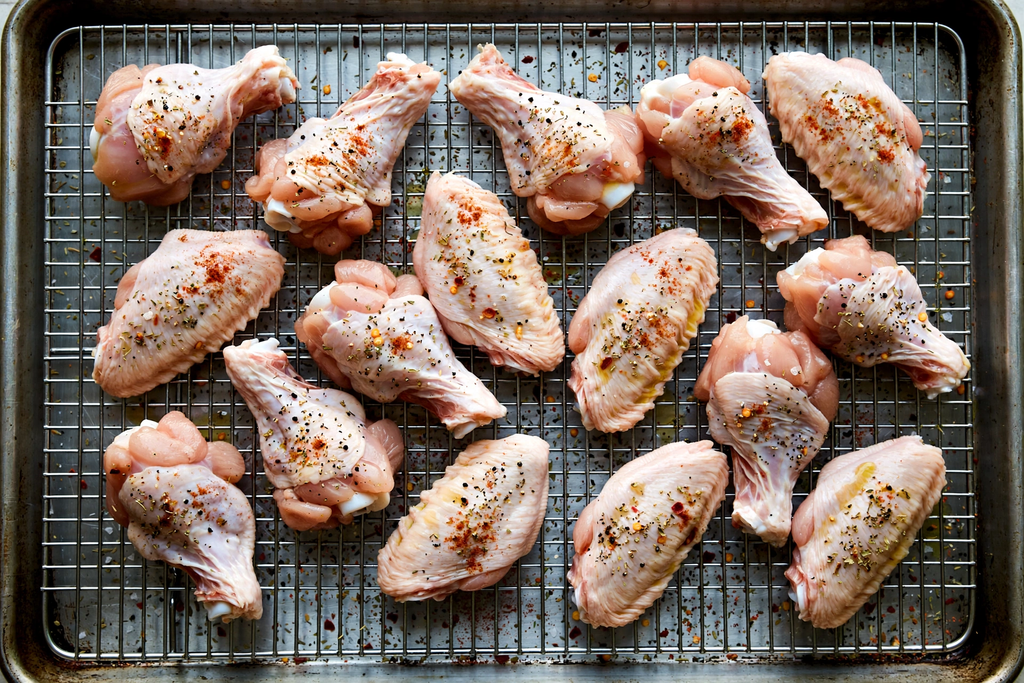
- Preheat oven to 250°F (120°C). Line a rimmed baking sheet with foil; set a greased wire rack on top.
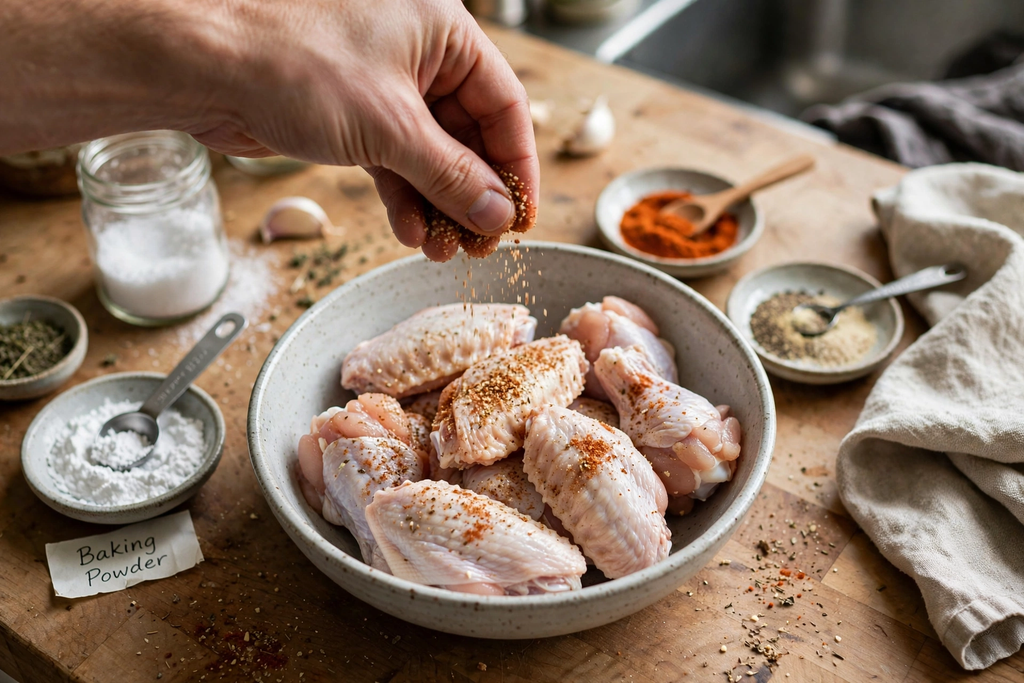
- Whisk baking powder, salt, paprika, garlic powder, onion powder, pepper, cayenne, and brown sugar.
- Toss dry wings in the mixture until thinly and evenly coated.
- Arrange skin side up on the rack in a single layer.
- Bake at 250°F for 30 minutes.
- Raise oven to 425°F (220°C); flip wings and bake 15 minutes.
- Flip again; bake 15-20 more minutes until deep golden and crisp.
- Stir melted butter, grated garlic, parsley, and lemon juice; toss hot wings in it.
- Serve immediately with celery, carrots, dip, and lemon wedges.
Notes
Why Baked Chicken Wings Are Worth Making
- Less mess: No splattering oil, no pot to clean, and no frying oil to dispose of.
- Hands-off cooking: Once the wings are on the rack, the oven does the work.
- Lighter result: The skin renders its own fat, so you need almost no added oil.
- Big batches: Two sheet pans can feed a crowd with the same effort as one.
- Flexible flavors: The same base wing works with dry rubs, buffalo sauce, honey garlic, BBQ, and more.
How to Bake Chicken Wings (The Basic Method)
Every great batch of baked wings follows the same eight steps. Learn these and you can cook any wing recipe.
Step 1: Start with the right wings.
Buy fresh or fully thawed wings. If you have whole wings, cut them into three parts: the drumette, the flat (wingette), and the tip. Use a sharp knife and cut through the joint. Save the tips in the freezer for stock. Many stores sell pre-split “party wings,” which save you time.
Step 2: Pat them very dry.
This is the most important step in the whole process. Lay the wings on a tray lined with paper towels and press more towels on top. Replace the towels if they soak through. Dry skin crisps; wet skin steams.
Step 3: Air-dry if you have time.
Set the wings on a rack over a tray and refrigerate them uncovered for 1 to 8 hours (or overnight). The cold, dry air of the fridge pulls even more moisture out of the skin.
Step 4: Coat with baking powder and seasoning.
Toss the wings with 1 tablespoon of aluminum-free baking powder per 2 to 3 pounds of wings, along with salt and spices. The baking powder raises the skin’s pH, helping it brown and blister.
Step 5: Use a wire rack.
Place a wire rack on a foil-lined sheet pan and spray it lightly with oil. Arrange the wings in a single layer with space between them. The rack lets hot air reach every side.
Step 6: Bake low, then high.
Start at 250°F (120°C) for 30 minutes to melt the fat under the skin. Then raise the oven to 425°F (220°C) and bake 30 to 35 minutes more, flipping once or twice, until the skin is deep golden and crisp.
Step 7: Check the temperature.
Wings are safe at 165°F (74°C), but they are most tender at 175°F to 185°F (80°C to 85°C). The extra heat breaks down the connective tissue around the joints.
Step 8: Toss and serve right away.
If you are using a sauce, toss the hot wings in a big bowl at the last second. Crispiness fades quickly once sauce is added.
Tip: An instant-read thermometer takes the guesswork out of every batch. Insert it into the thickest part of a drumette, avoiding the bone.
Ingredient Notes and Substitutions
Chicken wings. Choose wings of similar size so they cook evenly. Very large pieces may need an extra 5 to 10 minutes at the end. Pat frozen-then-thawed wings especially dry, since they release more moisture.
Aluminum-free baking powder. Always check the label. Baking powder containing aluminum can leave a faint metallic taste. Never swap in baking soda, which is much stronger and tastes soapy.
Salt. Kosher salt is gentle and easy to measure. If you only have fine table salt, use about ¾ teaspoon.
Smoked paprika. It gives the wings a deep, almost grilled flavor. Regular paprika works if that’s what you have, but the smoky version makes the rub special.
Brown sugar. A tiny amount promotes browning. It’s optional, and you can leave it out for a fully savory wing or for a lower-carb version.
Butter. The finishing butter is a flavor boost rather than a requirement. Skip it for a lighter, dairy-free wing and serve the wings dry with dip.
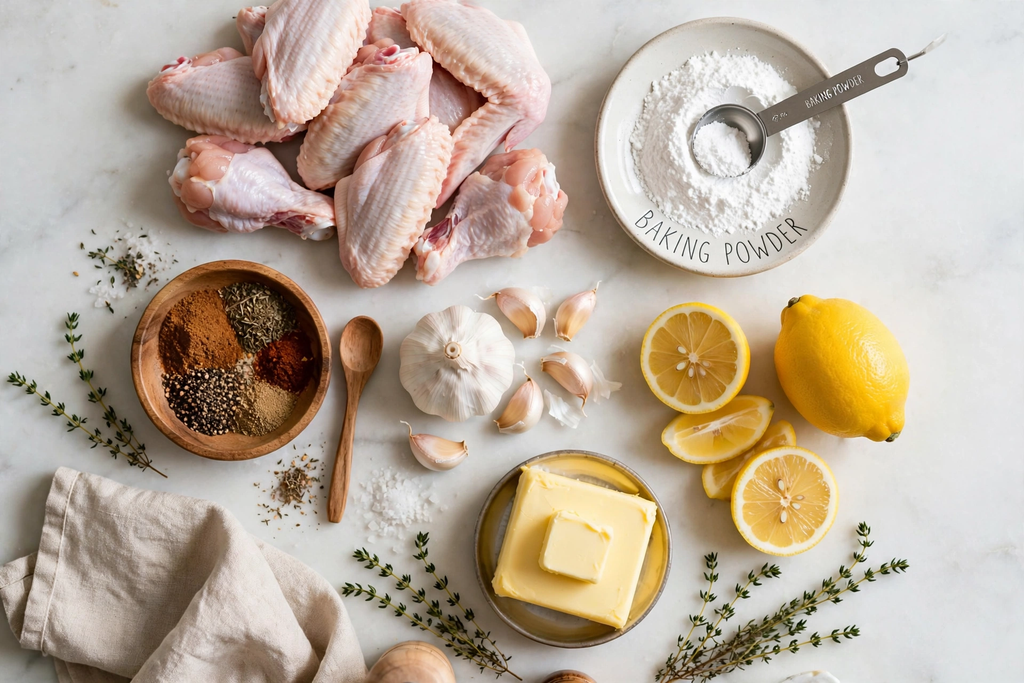
Baked Chicken Wings Time and Temperature Chart
| Method | Oven Temp | Approx. Time |
|---|---|---|
| Two-stage (crispiest) | 250°F, then 425°F | 30 min + 30 to 35 min |
| Single temperature, high | 425°F (220°C) | 45 to 55 min |
| Single temperature, medium | 400°F (200°C) | 50 to 60 min |
| Convection oven | 400°F (200°C) | 40 to 50 min |
| Frozen wings, no thaw | 400°F (200°C) | 60 to 70 min |
| Air fryer | 400°F (200°C) | 20 to 25 min |
Times vary with wing size and oven. Always check with a thermometer.
The Science of Crispy Wing Skin
Wing skin is mostly water, fat, and collagen. To make it crisp, you need to remove the water and melt the fat. A deep fryer does both quickly because the oil is extremely hot. In the oven, you have to do the same job more slowly.
The low-temperature stage gently renders the fat, which drips through the rack, and starts evaporating moisture from the skin. If you went straight to high heat, the surface would brown before the fat had a chance to melt, and the skin would be golden but chewy.
The high-temperature stage then crisps the thin, dried-out skin quickly. The baking powder helps the surface brown and creates tiny bubbles. Those bubbles are the blistered, crackly texture that makes baked wings feel fried.
Troubleshooting: Fix Common Wing Problems
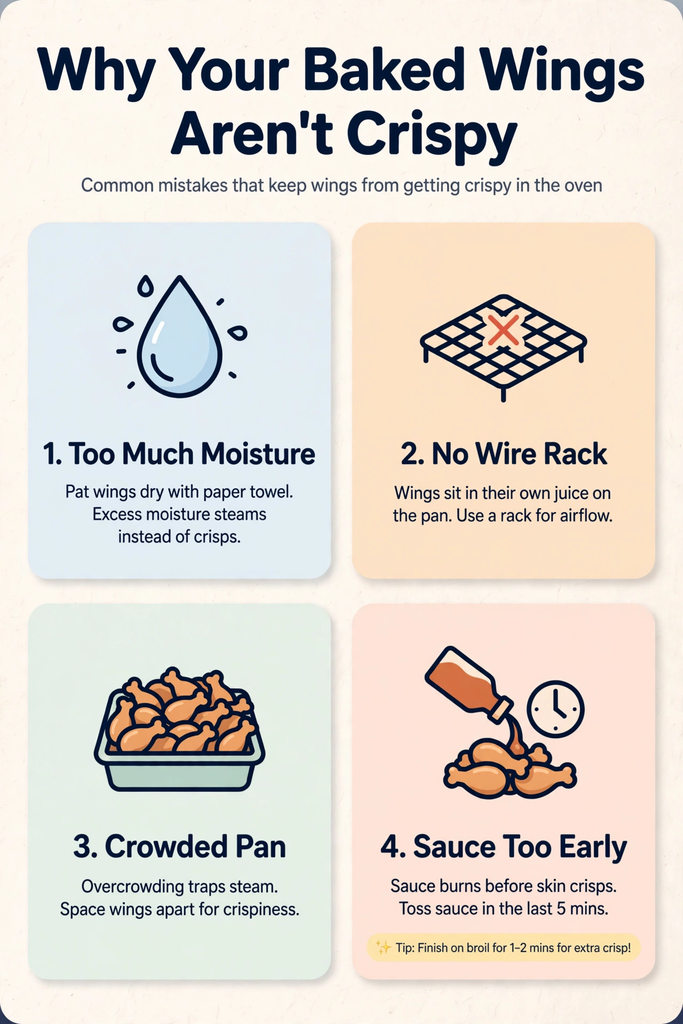
My wings aren’t crispy.
Moisture is almost always the cause. Pat the wings dry twice, air-dry them in the fridge, and make sure they aren’t touching on the rack.
The bottoms are soggy.
You probably skipped the rack or crowded the pan. Use a rack, leave space, and use two pans if needed.
The wings taste bitter or metallic.
You used too much baking powder or a brand with aluminum. Stick with 1 tablespoon per 2 to 3 pounds.
White powdery spots on the skin.
The coating wasn’t evenly spread. Toss the wings thoroughly and shake off any excess before racking.
The meat is dry.
Your wings may be small or your oven may run hot. Use a thermometer and pull them at 175°F to 180°F.
Skin is crisp but meat is chewy near the bone.
Return the wings to the oven for 5 to 10 minutes. Wings become more tender as they cook past 165°F.
Flavor Ideas: Same Wings, Different Sauce
Use the same baking method and just change the finishing step:
- Buffalo: Whisk ½ cup hot sauce with 4 tablespoons melted butter and a splash of vinegar.
- Honey garlic: Simmer honey, soy sauce, garlic, and a little butter until glossy.
- Garlic Parmesan: Toss with melted butter, garlic, grated Parmesan, and parsley.
- Lemon pepper: Toss with butter, lemon zest, and plenty of black pepper.
- BBQ: Brush with BBQ sauce during the last 5 minutes of baking.
- Sweet chili: Toss with Thai sweet chili sauce and a squeeze of lime.
What to Serve with Baked Chicken Wings
- Dips: Ranch, blue cheese, honey mustard, or garlic aioli
- Crunchy veggies: Celery, carrots, cucumber, and bell pepper strips
- Comfort sides: Baked fries, potato wedges, mac and cheese, or cornbread
- Cool sides: Coleslaw, potato salad, or corn salad
- Game day spread: Nachos, jalapeño poppers, and guacamole
Make-Ahead, Storage, and Reheating
Make ahead: Season the wings and refrigerate them uncovered on a rack for up to 24 hours. This actually improves crispness.
Refrigerate: Store cooled wings in an airtight container for up to 4 days.
Freeze: Freeze cooked, unsauced wings in a single layer on a tray, then move to a freezer bag for up to 3 months. Thaw overnight in the fridge.
Reheat: Bake on a rack at 400°F (200°C) for 10 to 15 minutes, or air fry at 375°F (190°C) for 5 to 8 minutes. Avoid the microwave, which makes the skin soft.
Nutrition Overview
Approximate values per serving (about 5 wing pieces) with the dry rub and a light drizzle of garlic butter:
| Nutrient | Approx. Amount |
|---|---|
| Calories | 380 to 450 kcal |
| Protein | 30 to 35 g |
| Total Fat | 27 to 32 g |
| Saturated Fat | 8 to 10 g |
| Carbohydrates | 1 to 2 g |
| Fiber | 0 g |
| Sodium | 450 to 600 mg |
| Cholesterol | 150 to 170 mg |
Good to know:
- High in protein: Wings are filling and support muscle repair.
- Very low in carbs: This dry-rub version fits keto and low-carb eating, especially if you skip the brown sugar.
- Lighter than fried: Baking uses little added oil, so these wings generally contain less fat and fewer calories than deep-fried ones.
- Sauces add up: Sweet glazes and BBQ sauce can add 10 to 20 g of carbs per serving.
Nutrition values are estimates and vary with wing size, ingredients, and portion. Use a nutrition calculator for exact numbers.
Frequently Asked Questions (FAQs)
For the crispiest skin, bake at 250°F for 30 minutes, then at 425°F for 30 to 35 minutes. If you prefer one temperature, use 425°F.
About 50 to 60 minutes, flipping halfway, until the skin is crisp and the internal temperature reaches at least 175°F.
No, but it helps a lot. Without it, dry the wings thoroughly, air-dry them overnight, and bake on a rack at high heat.
No. Baking soda is too strong and leaves a soapy taste. Use aluminum-free baking powder.
It’s strongly recommended. A rack lets air circulate so both sides crisp. Without one, flip the wings more often, though the bottoms will be less crunchy.
Yes. Flip once or twice during the high-heat stage for even browning.
165°F (74°C) is safe, but 175°F to 185°F (80°C to 85°C) gives the most tender texture.
Yes, but thawing first gives better results. From frozen, bake at 400°F for 60 to 70 minutes and pat off any moisture partway through.
Final Thoughts
Perfect baked chicken wings are not complicated. They just need dry skin, a little baking powder, a wire rack, and a low-then-high bake. Follow these steps and you will get crispy, juicy wings without the mess of frying.
Make a batch this weekend, then tell me in the comments which sauce or rub you tried. If this recipe helped, pin it for later and share it with someone who loves wing night.